Rock star, film director or actor - you haven't really made it to the top unless you own a vineyard. If you want to be up there with Aykroyd, Banderas or Coppola making your own wine is now an even better status symbol than a private jet. In the case of Barbara Laithwaite I suspect the motivation was different. Like her husband Tony, the co-owner of the UK's biggest wine company has stayed away from the limelight, and I'd be surprised if she'd own a jet. She also resisted the urge to buy an existing winery in California or Provence and instead planted vines in the Chilterns to make sparkling wine.

Fast forward a few years to find the Wine Rambler sitting down with a glass of 2009 Wyfold Vineyard brut.
We had heard a shy young Franconian winemaker talking about finding his own way, a sage dispensing Riesling wisdom, and the hulking star of the river Saar warn us of his own wines. But in spite of our heads beginning to spin, our palates starting to give out, and the lure of Dallmayr's fine sausages, cheeses and chocolates pulling us away, we had not yet heard enough...
Sample size issue?
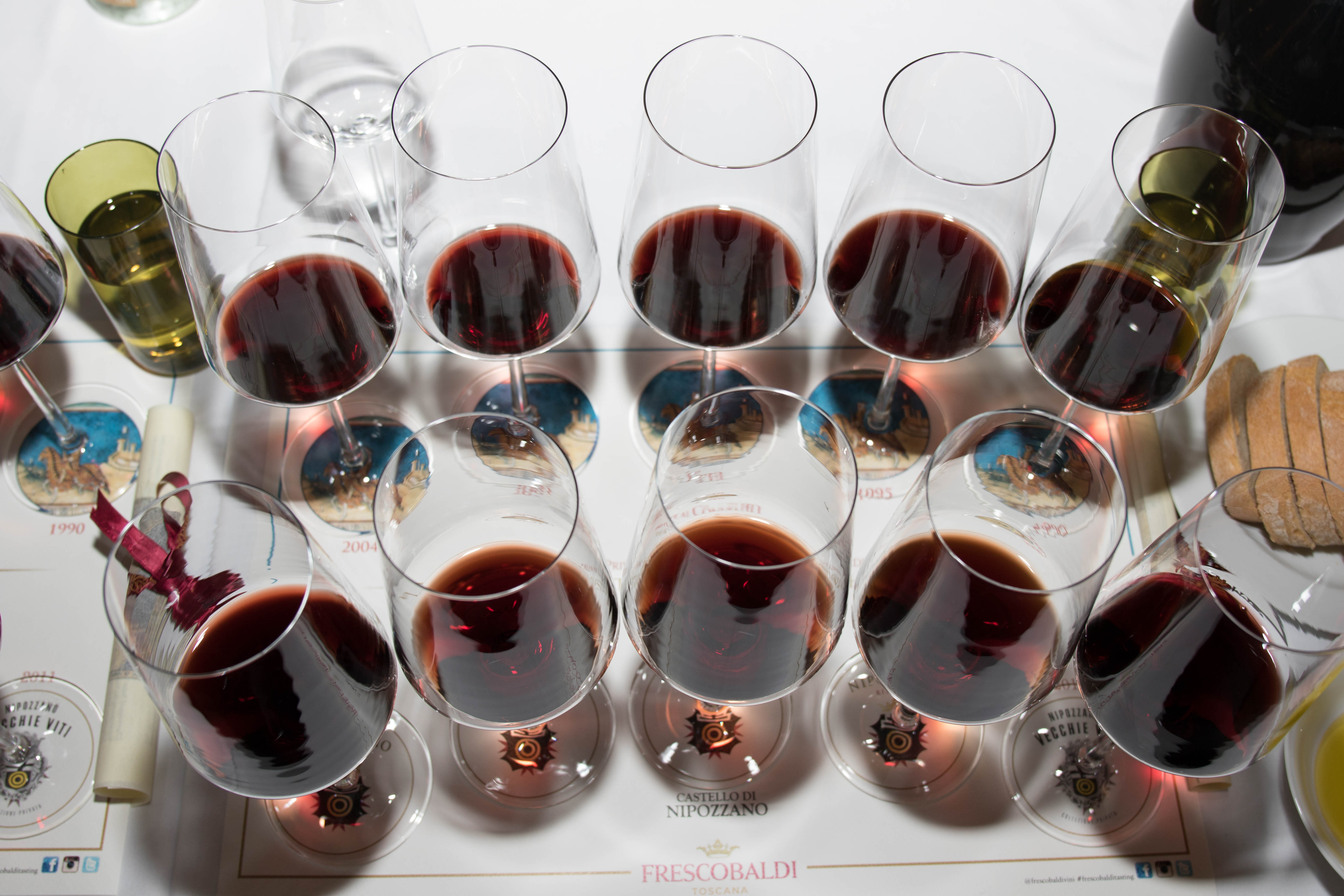
In case you missed the first part of this report about Winzerelite ("wine growing elite"), the annual spring tasting hosted by posh Munich wine and fine food store Dallmayr, in which we were talking.... No we weren't, really. We resolved to, this once, fulfil our journalistic calling and let winegrowers do the talking. One wine each, and whatever they wanted to tell us about it and what choices they made in making it - those were the rules.
A while ago a friend introduced the Wine Rambler by saying that "Torsten and Julian write about German wines, mostly sweet ones". Looking back over the last month, last few years in fact, it is easy to see that that's not true - this year we haven't featured a single sweet wine and only a couple off-dry ones. As much as that reflects the German trend towards "trocken" (dry) it is also a serious oversight on our parts. So, to make up for it we, er, give you another dry Riesling - because the first half of 2013 has been a really "dry" year for us. Well, unless you think of the weather of course.

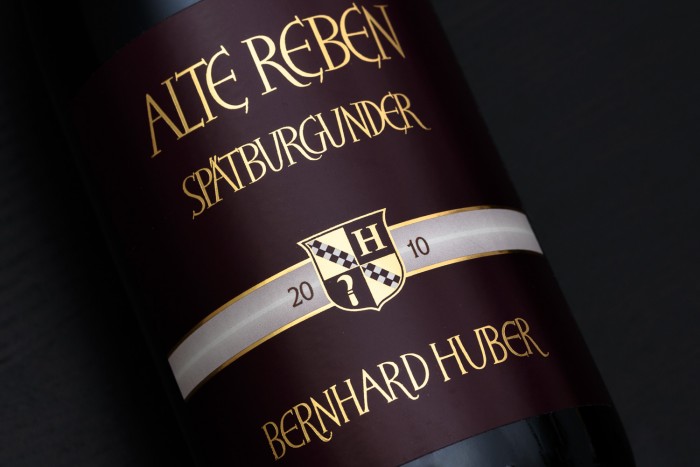
There will of course be sweeter times again, but for today let's turn to a German wine region that is not as visible internationally as it deserves, Rheinhessen, and an old vines ("Alte Reben") wine made by a young winemaker from grapes grown in a famous vineyard.
Nowadays everyone seems to expect the Spanish Inquisition. Well, maybe not exactly Monty Python's torture team with the comfy chair, but with the internet full of surprising wine finds presenting something unusual has become harder. Even so I hope that writing about German Syrah will be unusual enough to attract some attention - at least enough to keep you stuck to your chairs, trembling with anticipation, until my co-Rambler returns from his holiday to give you part two of Speak, barrel sample.

So here it is, the 2008 Syrah from a Baden producer who is at least as unusual and charming as his wines.
Two years ago, I reminisced about student days and staircases. Last year, I got all corduroy trousers and turtleneck sweater about the term "elite". Somewhat disappointingly, this has not stopped Dallmayr, the renowned Munich delicatessen store, from again using the name Winzerelite (wine making elite) for their annual spring tasting of German and Austrian estates. Clearly, we needed to try another tack with Dallmayr, who this year actually invited us to attend as - imaging our proudly beaming faces - press. From a friendly chat with Dallmayr's public relations guy, we gathered that they were happy to have bloggers spread the word, but not yet sure how to understand their reach compared to print journalism. Not a scepticism that you often hear in the English-speaking wine world these days, but we were happy to rise to the occasion: a new journalistic approach was clearly called for here.
pouring forth
We decided not to come along with a preconceived set of questions but to actually let the winemakers steer the conversation. We asked the men and women manning the stalls to pour us just one wine, their most important one. That should not have to be the most expensive one, nor necessarily the best, we insisted, but simply the one most worth talking about. And then we tasted, and we listened.
It does not always have to be Mosel. Nor does it always have to be Riesling. Well, there would be worse things in the world than to be limited to Mosel Riesling, but thankfully no demonic power has so far decided to make me choose between German wine growing regions. If that ever were to happen one of the other contenders would have to be the Pfalz. The Palatinate, as some of you may know it, is as large as it is diverse: amongst king Riesling and a range of other white grapes we see more and more exciting reds coming from the region west of Mannheim.

Like this Pinot Blanc most of the wines are dry. The Weißburgunder, as the Germans call it, comes from Koehler-Ruprecht, one of the renowned Pfalz estates. And damn is it drinkable!
Considering how well regarded it is Pinot is a fickle, confusing and rather unstable friend. With that statement I don't mean the wine but rather the grape - you stop watching it closely for just a second and, woosh!, does it mutate into something else. It can be so deceiving it will even confuse you when the mutation is over and it has become something else. Take the white Auxerois variety for instance that descends from Pinot: the first South African Chardonnay cuttings were actually Auxerois and when you think you drink an Alsace Pinot Blanc you could be fooled by 100% Auxerois.

The wine you are looking at here is more straightforward in that, as far as we know, it really is made from Auxerois - but with a twist still as it comes from the Netherlands, a wine region with so small a production that even many Dutch have not yet sampled its wine.
Following last week's review of a kick-ass aged Mosel Riesling it seems only fair to follow up with an exploration of a much younger Mosel wine's ass-kicking abilities. Today's hero may just be a baby in comparison but it comes with a good family history and a coup de grâce delivered by one of the grand masters of ass-kicking, Dr Indiana Jones.

Most importantly it comes with an airship (not included in the price sadly): "the wine most often drunk during the flights of the 'Graf Zeppelin' (airship)", as the label proudly claims in German.
Old wines are desirable, sophisticated and expensive - that at least is the general perception. Sadly this is usually not true as most wines don't age very well at all - just try the supermarket Chardonnay forgotten for five years in your cupboard to see why. However, and even more sadly perhaps, it tends to be true that desirable and sophisticated aged wines are expensive. Or are they?

How about I tell you that just a few weeks ago I bought the bottle belonging to the cork above for less than ten Euros - about half a Euro per year of age.
Natural wine is "in", no doubt. It fits the Zeitgeist of minimal intervention, non-industrial, organic, "honest" produce that is increasingly sought after by consumers. And yet there is also confusion. When I announced I was going to a natural wine fair I received lots of blank stares and the odd question of "you mean organic and stuff?" or "as opposed to unnatural wine?". That confusion partly comes from the fact that there is no generally accepted, legally binding definition so any wine can be marketed as "natural"; personally I also find some proponents of the movement a little overzealous. On the other hand I value sustainable winemaking and seek out artisan wines for individuality and character.
focus on natural wine
In short, I am both tempted and confused by natural wine, so last month's Real Wine Fair was a timely chance to explore the field and question my attitude. Or, to get into the musical theme of this post, "It's only natural / That I should want to / Be there with you."
I was in Freiburg recently for the wonderful occasion of the baptism of my niece. During the church service, the vicar who celebrated it at some point asked the congregation to join him in a prayer of interecession for the responsible production of healthy and sustainable food. Nothing wrong with that (I fervently joined in that prayer), but surely typical of that corner of the country, as it boasts the oldest organic food producers, highest density of organic anything stores and highest level of general relaxed left-liberal getting-it-right-iness in all of Germany. Small wonder that organic winemaking in the Kaiserstuhl sub-region of Baden, just an hour's bicycle ride away from Freiburg, also has deeper roots than elsewhere and is often into its second or even third generation.

Friedhelm Rinklin, a card-carrying founding member of the organic wine movement in Germany, also has basically done this forever. As early as 1955 already, his father had made the switch to biodynamic winemaking. I imagine that his son looks at those who discover organic wine growing just now with nothing but an ever so slightly raised eyebrow. Does his basic-range, very reasonably prices Pinot Gris exude the same wisdom and experience?
It's so annoying not to be able to call it Champagne, when it is Champagne. This statement about English sparkling wine comes from the Crown's "resident wine expert", the Duchess of Cornwall. It highlights a sparkling rivalry between England and France where the Frenchmen have law and reputation on their side: no matter whether you make sparkling wine in the same way (Méthode Champenoise) and to the same quality only fizz from the Champagne region may bear that prestigious name. The plucky Brits have no chance winning this battle but they do at least have a battle cry: the Méthode Champenoise actually is an English method.
Méthode Anglaise
The banner under which this battle cry is made is that of the three geese of Gusbourne, and it came to me on a bottle of fantastic sparkling wine.
Exciting and reliable - German car makers charge a premium for the promise of both, lovers almost by definition only deliver one and public services are rumoured to be neither. It is a desirable yet hard to find blend of characteristics, unless you turn to Knipsers' Kalkmergel Riesling.

Every vintage of this wine I have tried reliably delivered, and always in an exciting way.
Since the early days of the Wine Rambler I occasionally (and boldly I like to think) set out to explore the world of German wine as UK consumers experience it: in the supermarket. Despite many setbacks I have persevered, out of patriotic and journalistic duty. However, after the flop with German wine from Waitrose even I needed a break - and so I have switched both supermarket and country, in the hope that Tesco and New Zealand would deliver the goods.

And as if that was not enough firepower I also brought in the tenth most powerful woman in wine.
Dear Waitrose,
You are not like every other supermarket. You were the first to sell organic food in the UK. You have a royal warrant to supply the Queen. You are owned by your employees. And through your wine business you have won much respect, including mine.

That is until you sold me a bottle of "Piesporter Michelsberg" under the label of "Legends of Germany" as "one of the most renowned wines of Germany". Admittedly, this has not the same shocking ring to it as labelling horsemeat as beef, nor is it a health risk or illegal. And yet you are misleading your customers, thereby damaging the image of a product you and others have worked hard to restore to former glory: German wine.
López is sick. Like yours now my face may have shown a compassionately confused expression when I heard the sad news about poor López. My counterpart at least was very quick to assure me there was no reason to worry as López was not unwell at all, quiet the opposite. "López is sick.", it turns out, happens to be American for: "López make excellent wines." Now you may think the American wine writer I talked to was a little confused about language, but I can assure you she is not confused about one thing - López is indeed, er, sick.

And as this cool-climate loving, acid-hounding Riesling fan can fall in love with mature white Rioja, maybe you can too?
Can a glass of wine stop the work in its tracks? Okay, the millennium bug did non destroy the world in intercontinentally ballistic style in 2000, the great cosmic whatever that the Mayan calender predicted for 2012 appears to be off-schedule so far. The world's foundations had just started to look a lot less shakeable. But now this: A sparkler? From Haart? I should explain, maybe, that the very fine Haart family winery is my Co-Rambler Torsten's favourite Mosel winery, and has been featured here more times than any other. With their vibrant Kabinetts. With their supremely balanced Spätlesen. With their lip-smacking Auslesen. But never with a sparkler. Because there hasn't been one in our living memory.

But there it was, not to be denied or explained away. There it stood, a classy bottle, and a bit too heavy to be just a figment of some Rambler's unhinged imagination (but then, who would imagine such a thing, a Haart sparkler?).
There is no German wine that pairs with chocolate - this is what I have been told at a recent event on matching German wine with food. Whether you agree with this statement depends on what type of wine you would pair with chocolate of course. If you are amongst those who believe that sweeter red wines might work, well, then that statement is wrong. After all not only is about 40% of all wine made in Germany red, some of these do come in sweeter style too.

"Avantgarde", a semi-sweet Mosel red wine in an, er, avantgardistically shaped bottle is one of them. It is also a wine I have been scared of for a long time.
There are several philosophies about kids growing up to into mature adults, but the successful ones tend to include the Muppet Show. And as our readers naturally are mature adults I can take it for granted that you will know the Swedish Chef. As do I, of course. Apart from where I don't: in the dubbed German Muppets version I grew up with he is actually Danish. Confused as we may be in that regard, us Germans have loved Scandinavian food way before the success of Noma. And Scandinavians, it turns out, love to pair their food with German wine.
Scandinavian delights with Signe and Hannah
Scandinavia is a very important export market for German wine and earlier this month I received a tasty demonstration of how well our friend Riesling in particular pairs with northern cuisine.
If you have a look around on the Heymann-Löwenstein website you will eventually stumble upon a message from a Belgian wine merchant. He reports from a blind tasting of Champagnes into which he smuggled a bottle of Löwenstein's non vintage sparkler - and despite being the cheapest wine it got by far the highest score, beating the likes of Billecart-Salmon, Jacques Selosse and Ruinart. This is the type of underdog story that would usually be told about English fizz, but it doesn't hurt to remember that other countries also produce great wines made according to the classic Champagne method.

That Germany is one of them should not be a surprise, after all it consumes around a quarter of the world's sparkling wine and produces close to 400 million bottles a year.