Rheingau
The Germans and their compound words. Even people who haven't heard more than three words of German (presumably those will include "Achtung", "nein" and "Fuehrer", although amongst the more sophisticated "Kindergarten", "Zeitgeist" "Schadenfreude" und "Weltschmerz" are also candidates) know that the Germans like to build long words into even longer ones by attaching them to each other. Worry not though, I shall not be troubling you with yet another very complex word the length of the journey from Land's End to John O'Groats. Instead I will use a review of a Rheingau Riesling to introduce you to a short compound word every wine drinker should know.

The word is Zechwein.
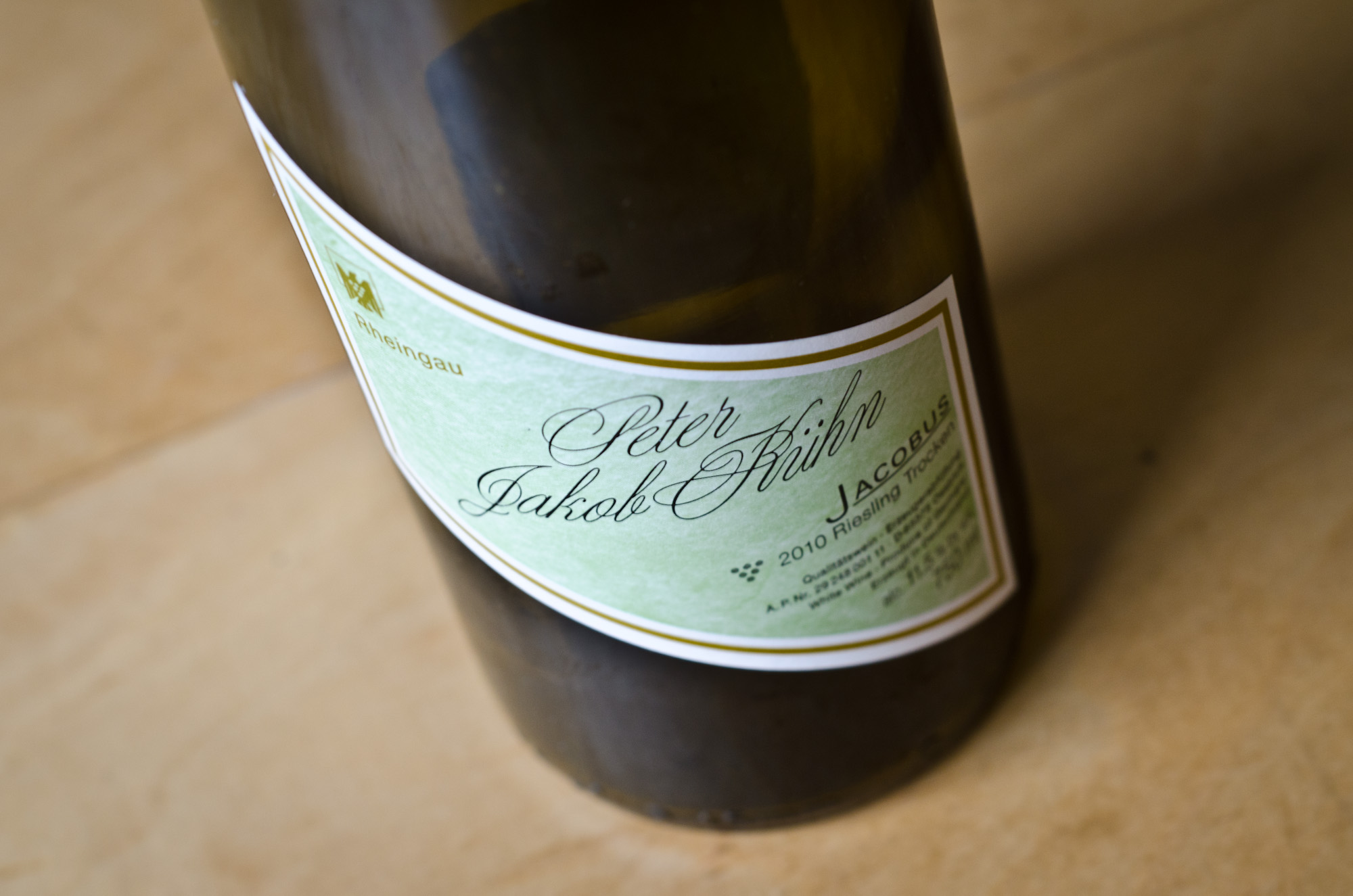
Last weekend I organised a wine tasting of a different type for my colleagues. I had particularly high hopes that one of the wines would shine, a Riesling from Rheingau winemaking wizard Peter Jakob Kühn. In the past, I have had some truly stunning wines from Kühn, and I had heard good things about his work with the difficult 2010 vintage. At the tasting though the biodynamic Riesling was overshadowed - in being controversial by a Franconian Silvaner and in receiving general praise by an Austrian Grüner Veltliner.

Not that the Riesling was bad, mind you, but in its leanness it was a little more quiet than I had hoped for. When we divided up the spoils of the night, I grabbed a half full bottle and took it home with me to inquire further.
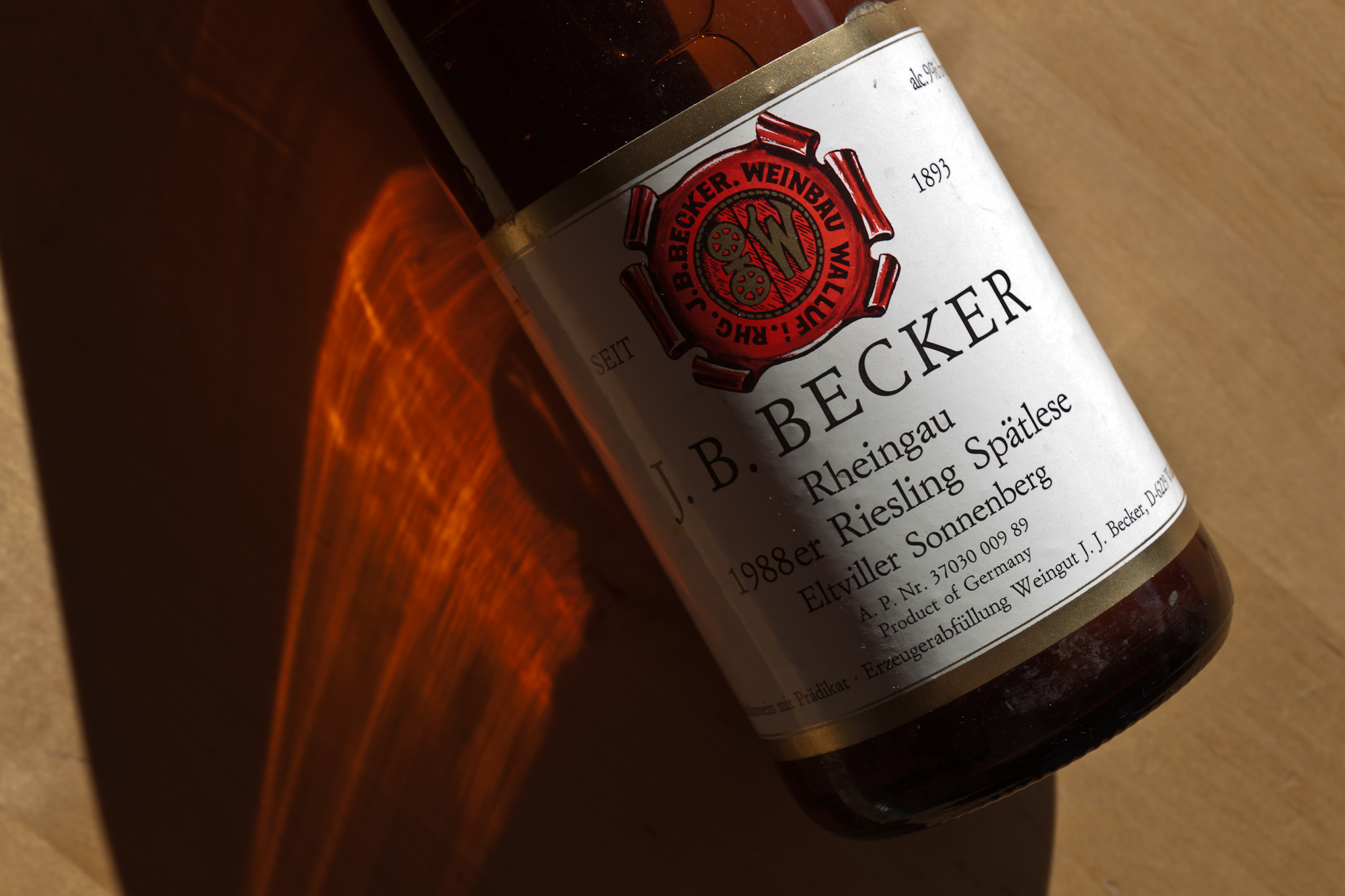
Contrary to the impression given by my recent confessional posting, I do not generally source my aged Rieslings by going through the neighbours' garbage. Here's one I bought absolutely regularly from a Munich wine shop. J. B. Becker is Rheingau winery known for the uncompromising traditionalism of its winemaking and the longevity of its Rieslings.

So while we are on the topic, I thought another little review may be in order:
Abroad Germany is mostly know for its delicious sweeter Riesling, but at home it is the top dry Rieslings that get most media attention. They are labelled as "Großes Gewächs" (great growth) or, in the Rheingau, as "Erstes Gewächs" (first growth), at least for the wineries that are members of the growers associations that created these classifications. Quality standards are relatively strict and include low yields, selective harvesting by hand and using only grapes from individual, certified top vineyards.

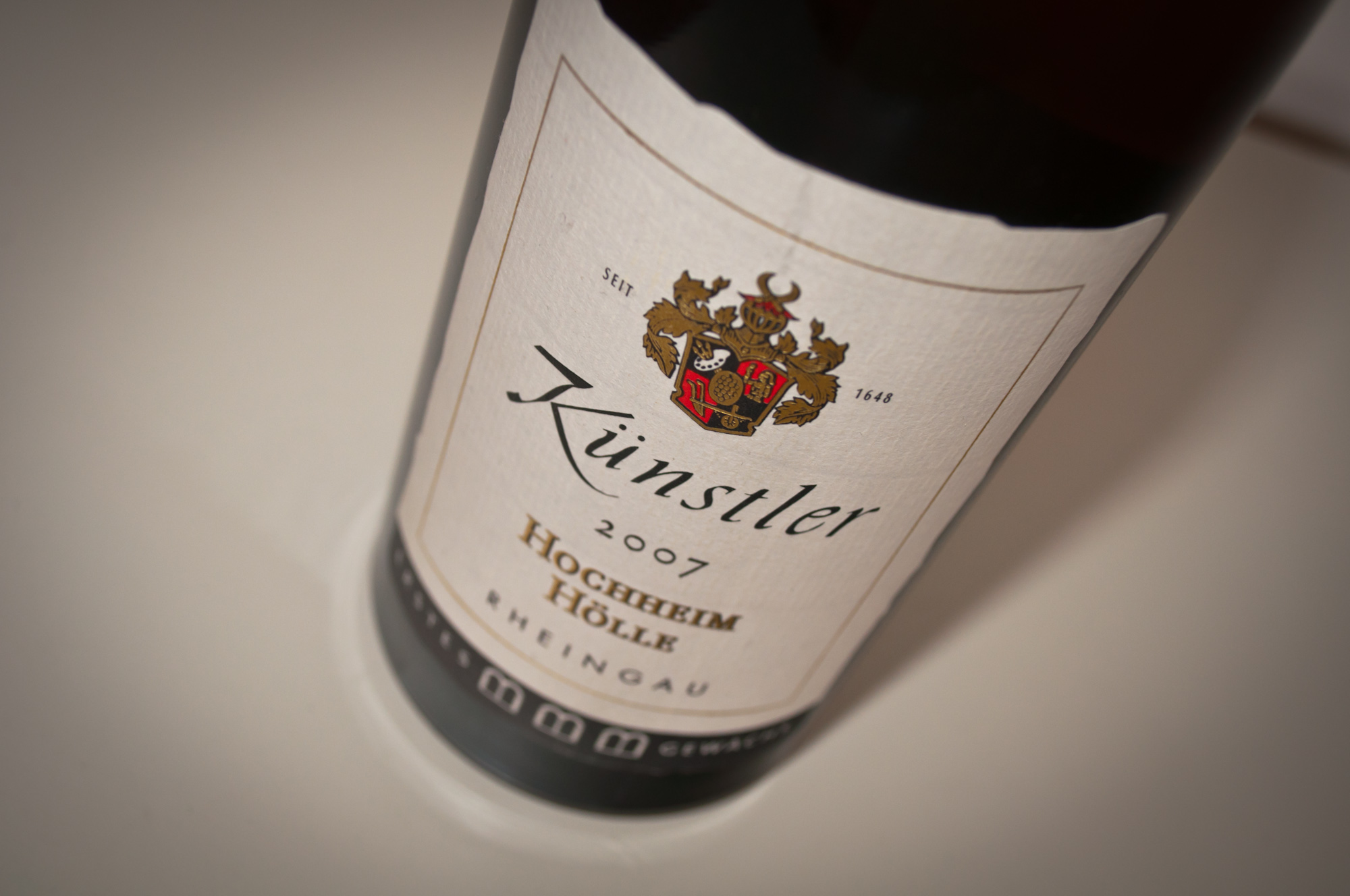
The price for these grand cru wines is constantly going up, so if you find one from a top producer such as Künstler for less than 20 Euro it is lucky times.
It is moments like this when I feel a little embarrassed to write about a wine. I often wish we had more wines to complain about so that we can prove that we are wine bloggers of the really critical sort. However, this is a blog about the wines we drink for pleasure, not for profit, so we try as hard as possible to find wines that we think we might like. When I bought this Riesling from the Rheingau, I hoped it would be good, really good. I had no idea it would be so good that even after going to bed I could still be heard mumbling 'this is fantastic'. Before you read on be warned though: you may seriously hate this wine.

Rheingau - rumour has it was here where Charlemagne had a vineyard and where the concept of 'Spätlese' (late harvest) was invented in the 18th century (albeit by accident). While red wine is on the rise pretty much everywhere else in Germany, the Rheingau (think of the Rhine near Wiesbaden/Frankfurt) is still unchallenged Riesling country. The Künstler family are among the most prominent producers in the area, known mostly for the Riesling from the 'Hölle' (literally 'hell') and 'Kirchenstück' ('church piece') vineyards.

Gunter Künstler certainly has a reputation for making outstanding Riesling. Many of his vineyards in the Rheingau are planted with old vines (think 50 years plus), or 'Alte Reben', as the Germans say. The Stielweg vineyard, where today's dry Riesling comes from, features loam-clay soil; the name comes from 'steep path', or 'steiler Weg'. The website sums the vineyard up as: 'The wine from these 50 year old Stielweg vines radiates aristocratic strength and nobility.' So what do we think?
In the heat of taking the picture I actually forgot to pour some wine in the glass...
Hessische Staatsweingüter Kloster Eberbach - this Pinot Noir was made by a state owned winery in the German state of Hessen. The Staatsweingüter (state wineries) are among the largest wineries in Germany, growing wine on about 200 ha. The Domaine Assmannshausen, one of three domaines that are part of this estate, focus exclusively on red wine, something quite unique in Germany. [read the full post...]
I would like to recommend this wine to all Anglo-Saxon wine lovers who enjoy the uniqueness of German wine labelling and, especially, naming. You might know that trocken means 'dry' and that Kabinett indicates that this wine is to be ranked among the quality wines. However, this is just the boring part of the classification system. Much more interesting is the name of the wine - artist's hell. How do the serious Germans come to such an usual name? [read the full post...]
This dry Riesling is a very pleasant surprise. Not that I would not trust the Weil winery to make nice Riesling - but I had seriously planned to just have a glass of this tonight. Or perhaps two. Alas! my plan has been foiled.
To be blamed is a dry Riesling with clear, yellow colour (not too intense). The nose is very fresh, almost cool, with mineral vegetable-lemon and a fruity dose of peach. The wine itself is dry, but not too dry, with a really pleasant freshness that makes your tongue tingle. [read the full post...]
While writing these lines I am sitting at my computer, looking out into the garden, a nice glass of German Riesling in front of me - and a friend from Germany connected in via Skype. And as it happens, she also has a Riesling in front of her. Obviously, no one will believe this, even if it is the truth - we did not plan it. But then she could have guessed that I would not be without a glass of wine, I guess.
What are we drinking? Benita has a 2007 Reinhold Haart Spätlese, a guarantee for delicious yumminess. While she is enjoying the more fruity option, I have the dry 2008 Riesling Kabinett from Robert Weil's Rhinegau winery - fresh, lemony acidity and peachy mineral vegetable; certainly not bone-dry. Very drinkable!
While the darkness descends over London, it is time to share some of the music that I am playing while we ramble about this and that, and life in particular.
"Merciful faith rocks this night"; here is the great great John Darnielle, aka The Mountain Goats: