Eurovine.de
Schäfer-Fröhlich (literally Shepherd-Cheerful) is the name of a very well respected, family-owned winery in the Nahe region. Despite a recent increase in red wine production, the Nahe is still mostly a white wine region, with Riesling being the most popular variety. The same is true for Schäfer-Fröhlich, a Riesling-focussed winery that over the past few years got a lot of good press. For instance, they were awarded the title of 'winery of the year 2010' by wine guide Gault Millau, they won the #1 Riesling trophy from Vinum wine magazine for 2009 and food magazine Feinschmecker crowned one of their 2008 Rieslings as the best dry Riesling in all of Germany. So you can imagine I was really looking forward to trying a Schäfer-Fröhlich, even if it was only one of their basic wines. Sadly, it did not quite live up to my expectations.

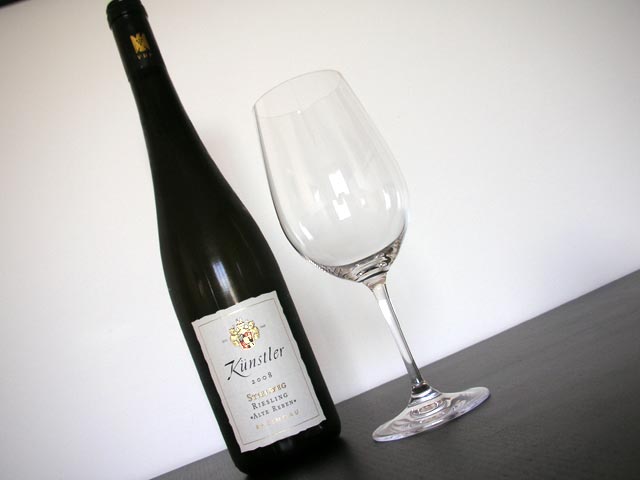
Gunter Künstler certainly has a reputation for making outstanding Riesling. Many of his vineyards in the Rheingau are planted with old vines (think 50 years plus), or 'Alte Reben', as the Germans say. The Stielweg vineyard, where today's dry Riesling comes from, features loam-clay soil; the name comes from 'steep path', or 'steiler Weg'. The website sums the vineyard up as: 'The wine from these 50 year old Stielweg vines radiates aristocratic strength and nobility.' So what do we think?
In the heat of taking the picture I actually forgot to pour some wine in the glass...
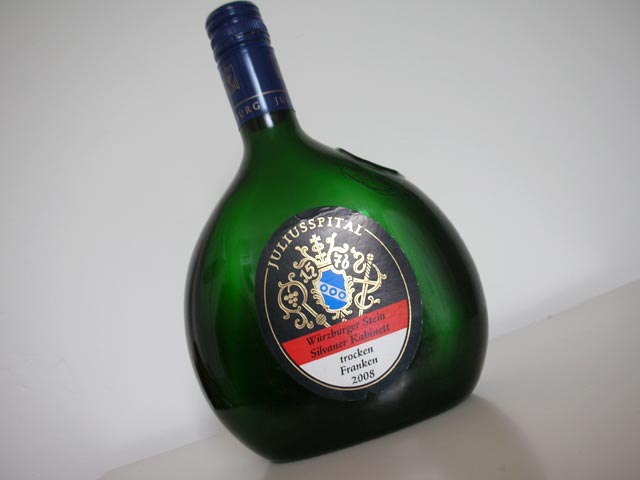
To the Wine Rambler, Silvaner remains one of the undervalued German grape varietals, particularly as seen from my London perspective. I don't think I have ever come across a Silvaner in a London restaurant or wine shop. This may not mean very much of course as Londoners would also find it difficult to get German Pinot Blanc or Pinot Gris, for instance, but I recently learned that even more knowledgeable wine people can confuse Silvaner with the (Austrian) Grüner Veltliner (Silvaner is sometimes called 'Grüner Silvaner'). Is this Silvaner from the Juliusspital winery going to change all that?

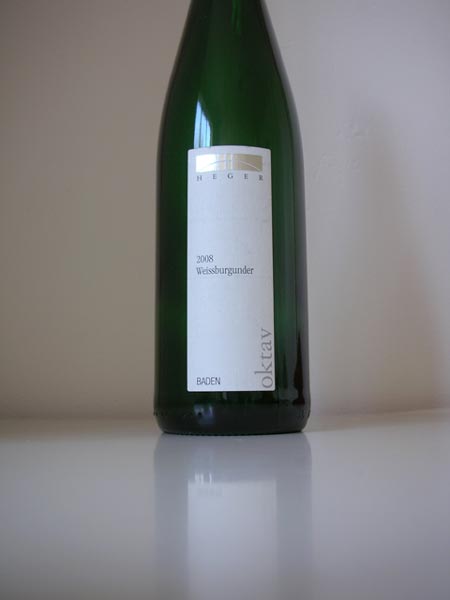
Yet again it is back to Baden for the Wine Rambler (this year I seem to drink more and more wine from Germany's sun-kissed southern wine region), and yet again a wine from the Heger winery: a surprisingly fresh and fruity, but otherwise very typical Pinot Blanc, if you want the short summary.

Imagine a hilly landscape somewhere in Europe. The sun is burning down. The temperature is way above 30° C. Sitting on a porch, you look around an area that was shaped by volcanic activity. While there is no lava any more, you have been told by locals that this small town is the warmest in the country. Your host returns to pour more Pinot Grigio. Southern Italy, you may think? Not at all! Chances are that you are sitting in the town of Ihringen in the South West of Germany, drinking a Pinot Grigio, Grauburgunder I wanted to say, made by the Heger winery. Well, it is still winter while I am writing this, but a few days ago I opened a bottle of a Grauburgunder, as the Pinot Grigio varietal is called in Germany, for two friends here in London - Dr. Heger's Oktav. [read the full post...]
The Wittmann winery recently got a lot of attention here on the Wine Rambler - and what is not to like? A wine making family with lots of tradition (been in the business since 1663), unafraid to try new things (they went biodynamic five years ago), and, well, more than capable to deliver the thunder to your wine glass. The latest Wittmann in our collection is no exception here, even though it is not entirely without problems.

I opened the bottle of Weißburgunder (Pinot Blanc) because I was looking for a dry wine with a bit of substance to be strong yet delicate enough to go with roast partridge. What I got was almost more than what I bargained for, because this wine is indeed quite strong.
Yellow colour with a shiny golden sparkle - very promising. The nose even better: cool mineral, herbs, lemon and peach - very pleasant peach indeed, but not overwhelming, and some apple, which adds just the right amount of bitter. The peach continues right onto your tongue, giving the Riesling an elegant juiciness, while the apple and especially mineral dominate the first half of the long finish. A wine with good structure, elegance but also a certain assertiveness, Georg Mosbacher's dry late vintage Riesling convinces from start to finish - even two days after I opened the bottle it stays sharp and clear. What can I say, a really good wine!
A fairly dark Pinot Noir, the 07 Vitus has a seriously dry nose: smoky, toasted oak, a little yeast and a little cherry fruit - more serious than playful, I would say. The wine is also not very fruity on the tongue, where leather and a hint of pepper are added to the mix. It does not feel heavy though, partly due to its fresh acidity. The finish is good, marinated cherries, acidity and tannins, but reasonably smooth, and a bit of woodland aroma with the tiniest hint of chocolate. [read the full post...]
People have very different ideas about wine labels, including people in wineries, of course, and that must be a good thing as it creates a certain variety. The artist-designed label of this year's GrüVe is certainly very distinctive, although I cannot say that I like the way in which it overpowers the whole bottle to the point that you see nothing else. But that just is the tradition of the Sonnhof estate's GrüVe label, an entry level Austrian Grüner Veltliner from one of Austria's premier wineries.
Hessische Staatsweingüter Kloster Eberbach - this Pinot Noir was made by a state owned winery in the German state of Hessen. The Staatsweingüter (state wineries) are among the largest wineries in Germany, growing wine on about 200 ha. The Domaine Assmannshausen, one of three domaines that are part of this estate, focus exclusively on red wine, something quite unique in Germany. [read the full post...]
This one is for the ladies. Actually, it is not so much for the ladies in general as for my friend Conny who always complains that the Wine Rambler ignores wine from the German region of Franconia, or Franken as we call it. Franken is a Protestant enclave in the north of otherwise Catholic Bavaria. People have a funny accent ('k' comes out like a 'g') and supposedly like robust food and dry wines with the necessary substance to go with it. Did I mention that Conny is from Franconia? [read the full post...]
Markus Schneider, an up-and-coming wine maker from the Palatinate, seems to like very simple, clean labels - a no-nonsense approach that has nothing of the sometimes overly decorated, old-fashioned German wine labels.
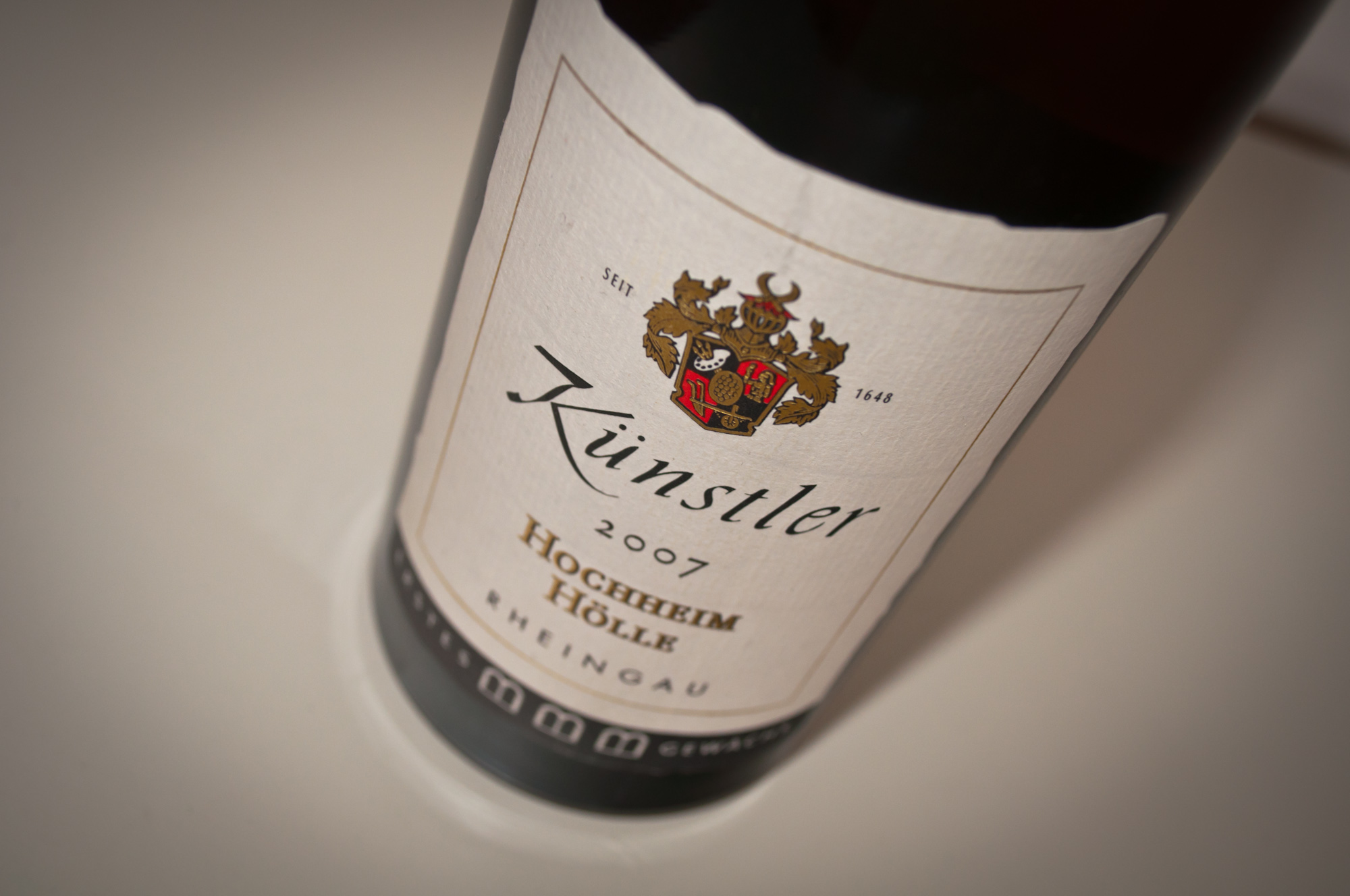
I would like to recommend this wine to all Anglo-Saxon wine lovers who enjoy the uniqueness of German wine labelling and, especially, naming. You might know that trocken means 'dry' and that Kabinett indicates that this wine is to be ranked among the quality wines. However, this is just the boring part of the classification system. Much more interesting is the name of the wine - artist's hell. How do the serious Germans come to such an usual name? [read the full post...]
This dry Riesling is a very pleasant surprise. Not that I would not trust the Weil winery to make nice Riesling - but I had seriously planned to just have a glass of this tonight. Or perhaps two. Alas! my plan has been foiled.
To be blamed is a dry Riesling with clear, yellow colour (not too intense). The nose is very fresh, almost cool, with mineral vegetable-lemon and a fruity dose of peach. The wine itself is dry, but not too dry, with a really pleasant freshness that makes your tongue tingle. [read the full post...]