TheWineRambler "A German wine label is one of the things life's too short for" - Kingsley Amis


sweet

These wines are sweet, meaning that either we or the winery have classified them so. This means that you are most likely looking at more than 45g of residual sugar per litre, with Auslese or some Spätlese wines potentially much more. Don't be afraid of the sticky stuff. Sweetness is your friend.
Posted by Julian 06 Jun 2010

Karthäuserhofberg. Nothing demonstrates the place vineyards occupy in german wine culture like wineries that are synonymous with the vineyards that surround them. This must put some pressure on the staff, must it not? If you work at a place called Karthäuserhof and produce wine from a site that has been called Karthäuserhofberg from time out of mind, you better not screw it up. Not to worry. They never do.

Posted by Torsten 01 Jun 2010

Recently, I found myself drinking with friends who were discussing which type of vegetable they would like to be. When I asked them how they would rate me, Charlotte suggested I could be a squash. Unfortunately I never really found out why she classified me in this way, partly because she went on to say she would quite like to be a courgette. Today's wine, luckily, is not like a vegetable. Instead it is very easy to describe in terms of fruit: take the most deliciously juicy peach you can imagine, add passion fruit, and caramelise it with lots of sugar and some gold, sprinkle finely with herbs and serve in a stony cup with a dash of menthol, spice and lemon juice. As you can see this description really does not work in relation to vegetables, but I can tell you that if this wine were a human being it would have to be the young Liv Tyler - just in blond.

Posted by Torsten 28 Mar 2010

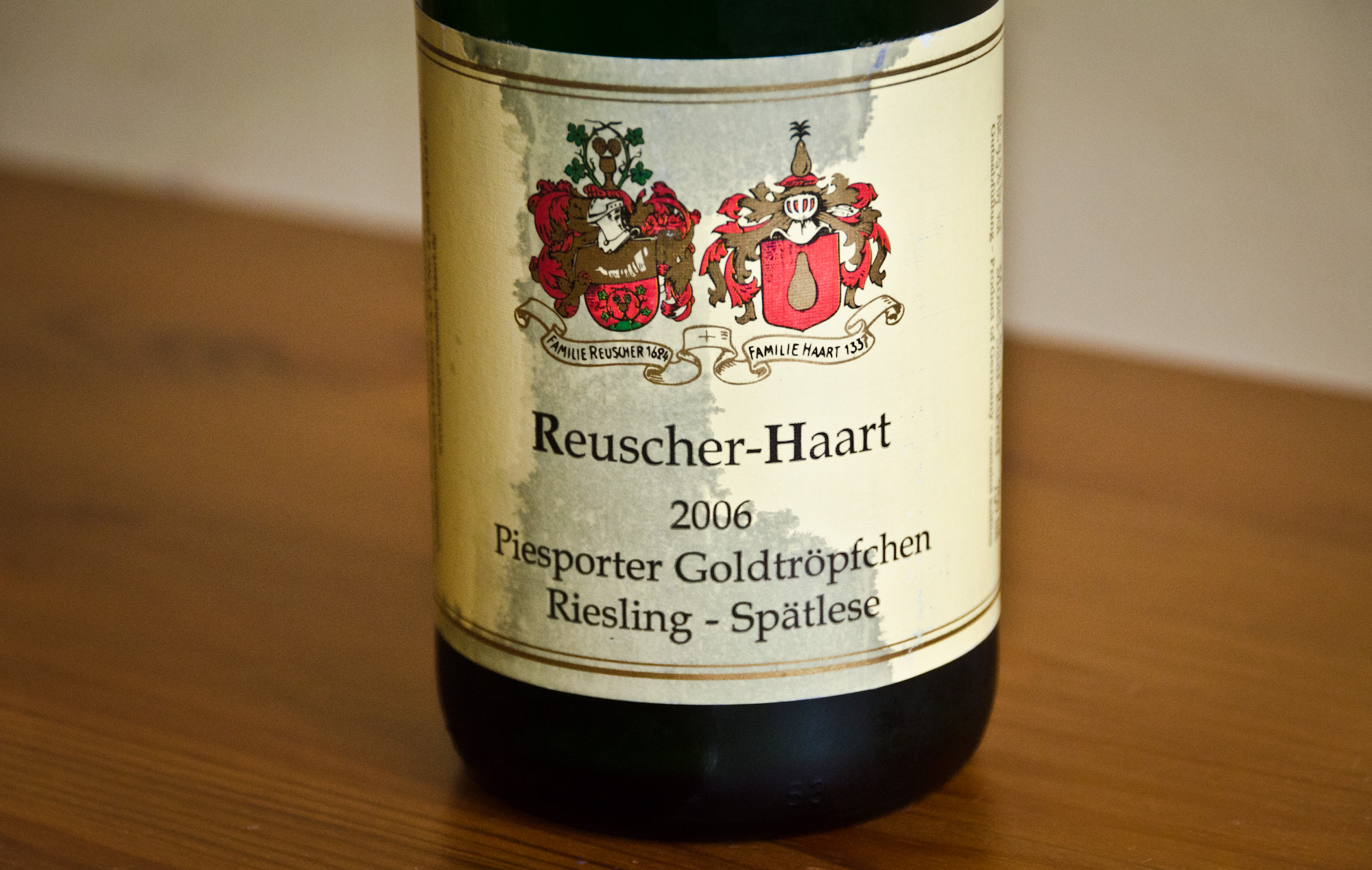
If you ask me to name a winemaker who has really impressed me with consistently, year for year letting the quality (let's avoid the word terroir here, shall we) of an outstanding vineyard shine, well, then I would probably name Theo Haart. Sure, there are others, but I have now tasted his late vintage Rieslings from the famous Piesporter Goldtröpfchen for the vintages 1999 and 2001-2008 (the 05 though is still sitting here, waiting for its day), and not only are they all first class wines, they are also very distinct and consistent in style. The '08 is no exception and, boring as it may sound when I write about Haart late vintage Riesling, just a lovely wine.

Posted by Torsten 07 Mar 2010

It has been a while, way too long, actually, since I reported on a wine made by the lovely people from the Haart winery. The winery is based in the village of Piesport, a name that is infamous in the UK for cheap wine, but famous among wine lovers for the Goldtröpfchen (little drop of gold) vineyard, one of the best at the Mosel. The Haart family has been making wine since the 14th century and the sweet Rieslings of Theo Haart, who runs the family estate with his wife and son, have an excellent reputation. For me they are also the embodiment of what I love about the Mosel style of winemaking.

Posted by Torsten 02 Jan 2010

It was New Year's Eve and the Wine Rambler committee had assembled in Munich to drink some god-damn wine. And what could be better to conclude an evening of feasting and drinking with friends than one of the elegant, sweet Mosel Rieslings that Theo Haart turns out year after year? To celebrate the end of 2009 it had to be something special, an 'Auslese' ('selection', one of the highest ratings in the often confusing and not always meaningful German wine classification system). Made by a good winery and stored well these wines can last for decades, so a 2006 Auslese can almost be seen as a young wine when drunk at the end of 2009. Or as darn tasty, at any time. [read the full post...]

Posted by Julian 17 Nov 2009

What to write about a wine that's so annoyingly perfect that it has the peachy fruit, has the stones, has the sweetness, has the acid, has those first camomile and petrol hints of age, has the balance and has all the elegance that sweet Riesling can bring.

Not much to say about a wine which will let any of the Wine Rambler's snobbish bonmots and bad puns roll of it anyway.

I'll make this confession, then: Us having enjoyed this with a dear friend who not only makes a fiendishly good mousse au chocolat, but also likes good Spätlesen, amid general contentment, I couldn't help this thought creeping its way into my sluggish brain: This wine is too nice. Yeah, it's boring. There, I've said it.

Posted by Torsten 25 Aug 2009

If you like aged Riesling, if you want a perfectly balanced, well rounded wine, if you crave the sensation of a wine that makes your palate feel smooth and peachy - go for this gem from the Mosel. Followers of the Wine Rambler will have noticed that we do tend to like the fruity Rieslings Theo Haart makes and this one is no exception. It is, in fact, the oldest Haart we have tasted for the Rambler and it demonstrates the potential of these wines. [read the full post...]

Posted by Torsten 17 Aug 2009

Is there anything better than a nicely aged, excellent Riesling? I am not sure, but drinking this late vintage from winemaker Haart makes me think there may not be many things that would be better.

Posted by Julian 07 Aug 2009

German department store chain Hertie / Karstadt is broke, and the market on my way to work is one of those that are to close permanently. I couldn't help but look in on its second-but-last day out of morbid curiosity. Amid the eery atmosphere of an empty supermarket, on one of those cheesy fake barrels of the wine section, I found them: Ten or twelve little golden half-bottles, like a lost flock of ducklings, sporting blowout price tags, but shunned by the bargain hunters. One I took home.

Wirsching is one of Franconia's most reputable producers, with hefty dry Silvaners. "Wiqem" is a rip-off on Chateau d'Yquem, of course, the world's best know dessert wine. Even the lable mimics Sauternes. It's a sweet Auslese made from a mix of grape varieties.

Golden colour. [read the full post...]

Posted by Julian 25 Jul 2009

Straw-coloured. Fairly understated smell of candied citrus peel, camomile tea and a hint of petrol.

The taste is so much fresher and more open: Wonderful rich sweetness, elegant ripe pineapple notes, the world's fruitiest camomile tea, the tiniest hint of caramel, good stable acidity, a mineral background. What makes this Spätlese wonderful is that it has the complex flavours of maturity (the typical lemon, peach and apricot aroma of young riesling is almost completely gone), but is still vibrant and fresh. It seems that, out of pure luck, I have opened it at a very good point in its development.

From a region not often talked about, a producer to watch out for.

Posted by Torsten 22 Jul 2009

Light golden colour. At first, the nose is a little closed - mineraly yeast with herbs and a hint of peach; not unpleasant, but also not very intense. And while you still wonder where Dönnhoff is going with this, something gorgeous hits your taste buds. Even within seconds after opening the bottle, the sensation on your palate is just marvellous. And it gets better over time, as does the nose. [read the full post...]

Posted by Torsten 18 Jul 2009

White crystals on the cork. Shiny, golden colour. A nose of (flowery) honey and stone fruit, with a faint hint of mineral; peach. In the mouth honey, smooth, caramelised peach, very smooth, a little spice, nicely aged. At first, we noticed a little malt in the finish (think malt beer), but that disappeared after 15 minutes or so; a little bitter towards the finish - not entirely unpleasant though. It made me want to have a soft, not too sweet cheese cake.

A nicely aged Riesling that was very drinkable but lacked that little something to be truly, truly memorable.

Posted by Torsten 10 Jul 2009

Intense yellow gold colour. A nose of honey and peach, with a hint of a medicinal smell (that almost completely faded away after a few hours). A thick and creamy sensation in the mouth - according to the producer this baby has 190 gram of residual sugar per liter - and a flavour mix of peach and honey with a decent kick of spice. Initially, the Eisgöttind (ice goddess) reminded me of a Sauternes, but the fresh spice gave a welcome contrast to the sweetness. Still a very heavy wine, the kind of wine that ends the drinking for that day, full stop. Yummy as a desert wine, perhaps a bit too heavy for me to drink on its own - I guess I will just always be a sucker for the light Mosel late vintages.

Posted by Julian 26 Jun 2009

Mosel Tributary with 5 letters? RUWER

Rieslings from the Ruwer are known for their strong acidity and their slim elegance. From the Schlosskellerei (more commonly known as Maximin Grünhaus), one of the three top estates from there, comes this delightful cabinet: [read the full post...]

Posted by Torsten 20 Apr 2009

This Knipser demonstrates nicely how a nice, juicy Riesling can taste when it trades some freshness for a little saturation. Mineral, peaches, lemon and herbs with a little acid and signs of age - a juicy, full bodied peach melting on your tongue with a little creamy mineral. Different in character from the Riesling I usually have and hence very welcome, especially as you feel this wine has substance without being oaked to death.