dry

These wines are dry, or 'trocken' in German terminology, - either according to our palate or the classification of the winery.

Weingut Ziereisen, Blauer Spätburgunder, 2008

If you ever come across ruddy-cheeked, twinkly-eyed, chatty Hanspeter Ziereisen, do me a big favour: Don't underestimate him. And do yourself another: Try his wines. There has hardly been another Pinot Noir winemaker in Germany who has a more consistent, sharp-edged stylistic vision for the grape, or taken a more principled, self-critical and determined path to realising it. Excepting maybe Bernhard Huber in Malterdingen, we know of no greater francophile in german Pinot than Hanspeter Ziereisen. High time he made his debut on the Wine Rambler.

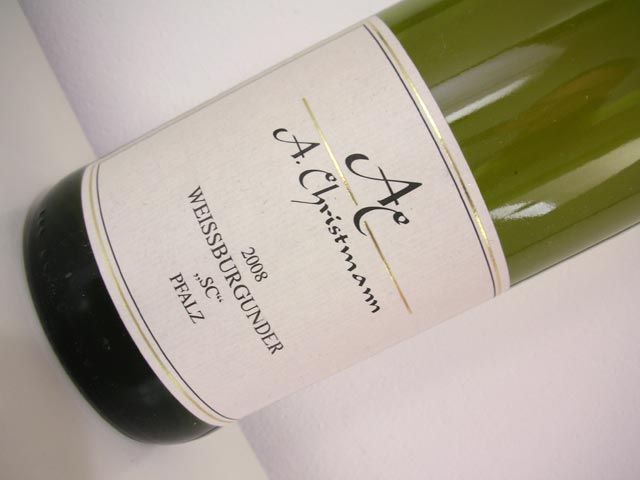
A. Christmann, Weißburgunder "SC" Pfalz, 2008

The more Pinot Blanc I drink, the more I appreciate this grape variety. While you will find Pinot Blanc in France and, known as Pinot Bianco, in Italy, Germany is the country that grows more of it than any other: Weißburgunder, as it is known here. The Weißburgunder I am reporting about today was grown in the Pfalz, near the village of Gimmeldingen where the Christmann winery is based. The estate has been owned by the Christmann family for seven generations. It is headed by Steffen Christmann, who also happens to be head of the 'Prädikat Wine Estates', Germany's club of premier estates. In 2004, Christmann changed to organic production and recently even to biodynamic methods. I could not say whether this is the reason for a consistently high quality, but Christmann is certainly doing something right. Now let's have a look at this Pinot Blanc, shall we?

Dr. Heger, Oktav, Grauburgunder Kabinett, 2008

Imagine a hilly landscape somewhere in Europe. The sun is burning down. The temperature is way above 30° C. Sitting on a porch, you look around an area that was shaped by volcanic activity. While there is no lava any more, you have been told by locals that this small town is the warmest in the country. Your host returns to pour more Pinot Grigio. Southern Italy, you may think? Not at all! Chances are that you are sitting in the town of Ihringen in the South West of Germany, drinking a Pinot Grigio, Grauburgunder I wanted to say, made by the Heger winery. Well, it is still winter while I am writing this, but a few days ago I opened a bottle of a Grauburgunder, as the Pinot Grigio/Gris variety is called in Germany, for two friends here in London - Dr. Heger's Oktav.

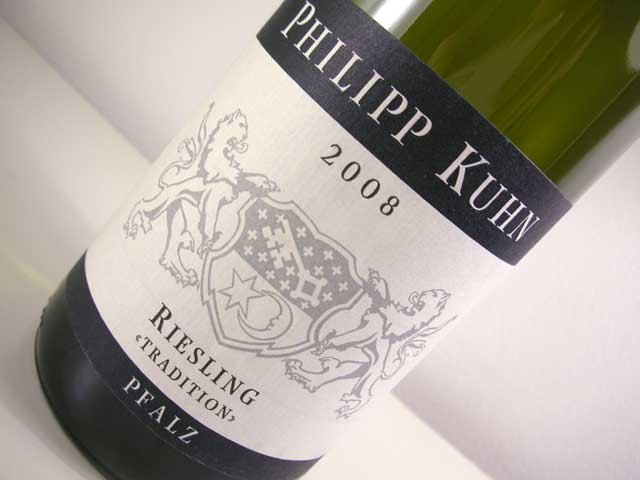
Philipp Kuhn, Riesling Tradition, 2008

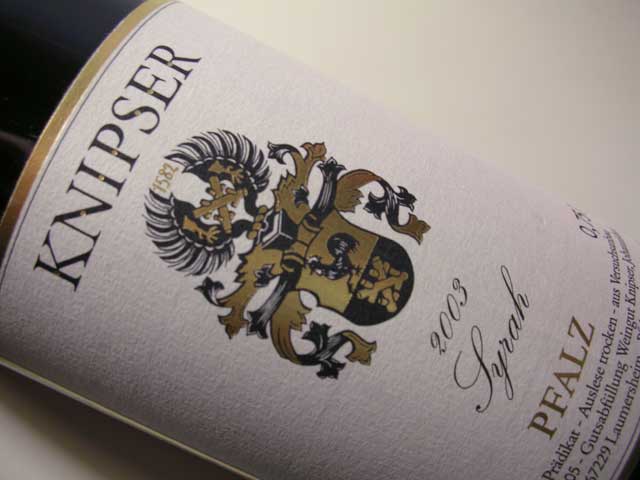
If you have ever come across the German village of Laumersheim, chances are it was because of a wine. Laumersheim is home to the Kinpser winery, a family owned estate that makes some of the best red wines you can get in Germany (and marvellous white wines too). And it is home to the Kuhn winery that is getting more and more attention, especially after Philipp Kuhn in 1992 - at the tender age of 20 - got involved in the family owned estate. You may be surprised to hear that the winery is not only producing some red wine, in fact about 50% of the wines made there are red. The delivery that brought this Riesling to London also included a Merlot! The story of red wine made by the Kuhns in the Palatinate will have to be told another night as tonight we are drinking the entry level Riesling from the Kuhn winery (entry level, by the way, does not mean mass-produced: harvests are limited to below 75 hl per hectare).

Bernhard Huber, Malterdinger Bienenberg Spätburgunder, 1992

Whenever the invitations to those '47 Petrus and '86 Lafite tastings go out, somehow our names seem to get passed over. Shame, but that doesn't stop us from embarking on the adventure that is aged wine from time to time. Today, an 18 year-old german Pinot Noir. This ol' boy comes in a light, cloudy cherry red with brown edges. If you want to know how great decaying leaves, wet earth, manure, marinated cherries and smoked bacon smell when mixed together, I suggest you stick your nose into this.

Takler, Cabernet Franc Szekszárd, 2006

Another venture into Eastern Europe, and into a grape that I like more and more: Cabernet Franc.

Very dark red, a little cloudy (unfiltered, probably), with a purplish edge. Smells of stewed vegetables, beetroot, ripe red peppers, but meaty at the same time. In the mouth, it brings rather hard-edged cassis and tar at first, Cabernet Sauvignon-style, but with more exposure to air, the sweeter and more savoury vegetable flavours take over. While the ripe fruit and oak flavours lean toward the international style, the vegetables give it character and spice.

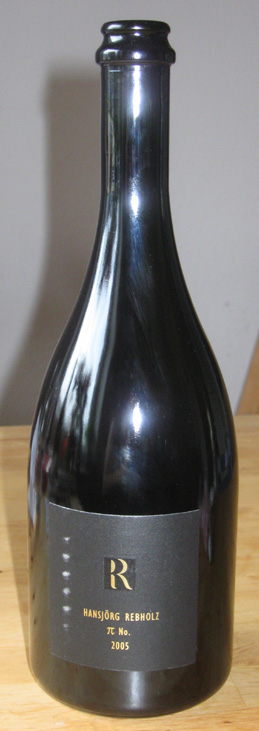
Ökonomierat Rebholz, Pi No "R", brut, 2005

Nine days into the new year and we're already sticking our noses into the sparkling wine again. Is that hedonistic cheek on our part or a commendable discipline in making good our new year's resolution number 2? Actually, it's neither, since this is a postscript to our new year's eve.

Lively, but not over-strong bubbles, a smell of ripe apples and quince. Bone dry and almost austere at first taste, but at the same time fairly creamy and intense, with the tiniest hint of oak maybe, and in the end, it's mature quince and apple fruit again, maybe also a hint of tangerine, with very fresh acidity all the way through.

Palivou Estate, Ammos, 2006

Read the background story to this wine here (be warned: It's quite a ramble)

A very dark cherry red in the glass, this brought sweet cherry juice, blackberries and a little fruit jam to our noses. The mouthfeel is, again, dominated by marinated cherries, dried fruit, and a chocolate pudding aftertaste.

It's a measure of the quality of the winemaking that this overripeness does not pull it out of balance, but a gentle tannic backbone wraps up the taste in the end.

Julian Monday, 04/01/2010

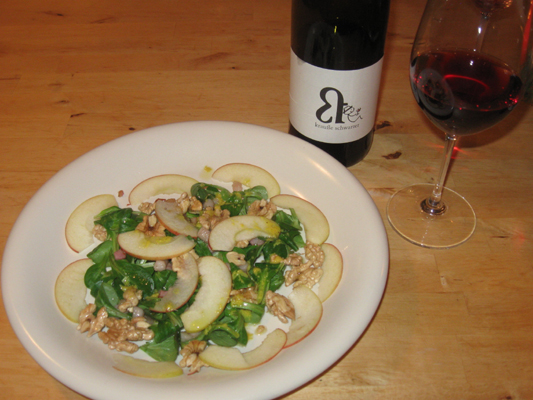
Lukas Krauß, Krauße Schwarzer, 2008

Winter evenings, we are constantly reminded, are the time to open the big reds, bring out the big guns, release the heavy hitters. That may be so, but light, elegant reds that do not clobber the food or the taster are always in season.

From Blauer Portugieser (a red grape once common across Germany, Austria and eastern Europe but now declining), and Schwarzriesling (nothing to do with Riesling, but Pinot Meunier, of blanc-de-noirs champagne fame), Lukas Krauß makes this wonderfully bright cherry-coloured wine, named in honour of his grandfather.