dry

These wines are dry, or 'trocken' in German terminology, - either according to our palate or the classification of the winery.

Heymann-Löwenstein, Schieferterrassen, Riesling 2008

Sometimes something is in the air. A few days ago I realised that we actually never reviewed a wine made by Reinhard Löwenstein. And as it so happened a bottle of his Riesling found itself uncorked last weekend - and not only here in London, but also in Munich where fellow Wine Rambler Julian enjoyed a 2004 Heymann-Löwenstein (we did not coordinate this). Read his excellent review of a gorgeous wine, especially as it will tell you why you should keep an eye on this extraordinary winery. As Julian has already set the context, I can keep this review of the more basic 2008 Schieferterrassen Riesling rather short.
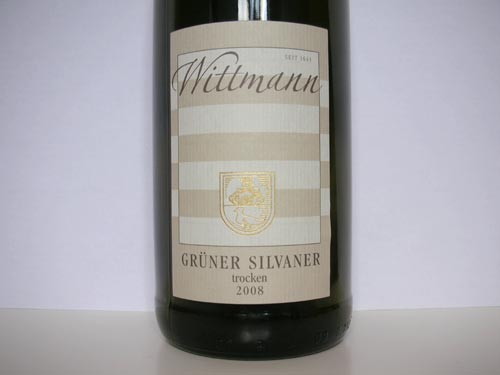
Wittmann, Grüner Silvaner trocken, 2008

Just one glass. This was my excuse to try this Silvaner. Why just one glass? Well, I have been down with the flu since Thursday night (six days, I know), but earlier tonight I felt well enough to think about having a small (!) treat.

Why a Silvaner, you may ask? First of all it is the year of the Silvaner grape in Germany. Secondly, I was planning to have sage risotto with caramelised apples and roast walnuts, and I wanted to have a light apple-y yet robust wine to go with it. And thirdly, I just had a discussion with Kathryn from Artisan & Vine about natural wines from Germany - and this surely is one. Wittmann is one of the leading German estates and for quite a while now they have been focussing on organic wine. And this Silvaner here, well, it is quite something, for a 'simple' wine.

Fürst Hohenlohe-Oehringen, Verrenbergerer Verrenberg "Butzen", Lemberger trocken 2007

The winery Fürst Hohenlohe-Oehringen has already impressed the distinctly non-aristocratic wine rambler with its marvellous top-of-the line red "Ex flammis orior". And the Lemberger red wine grape of Württemberg, as our regular readers know, is no other than Austria's and Hungary's Blaufränkisch. In the new spirit of german patriotism summoned by german liberal democrat and possible future foreign (!) minister Guido Westerwelle, who refused to answer an english question from a BBC reporter with the witty and adroit words: "Wir sind ja hier in Deutschland", we should probably not even tell you that. So, let's turn to a german wine from a thoroughly german grape:

Weingut Bercher, Burkheimer Feuerberg, Weißburgunder Kabinett trocken, 2007

The wine rambler could not agree more to the statement from the excellent german WeinPlus online wine guide "Year after year, Bercher impresses us with their completely unpretentious, yet deep and expressive wines".

This mid-range single vineyard Pinot Blanc justifies the praise with effortless precision wine making: Dense straw colour, a nose of caramel, buttered biscuits and melon juice spilled over hot stones. Dense, polished fruit in the mouth, mineral background, good acidity, and above all, a freshness and drinkeability that is not a matter of course, the Kaiserstuhl almost having turned into a hot-climate wine region in recent years.

Hessische Staatsweingüter Kloster Eberbach, Domaine Assmannshausen, Assmannshäuser Höllenberg, Spätburgunder 2007 trocken

Hessische Staatsweingüter Kloster Eberbach - this Pinot Noir was made by a state owned winery in the German state of Hessen. The Staatsweingüter (state wineries) are among the largest wineries in Germany, growing wine on about 200 ha. The Domaine Assmannshausen, one of three domaines that are part of this estate, focus exclusively on red wine, something quite unique in Germany.

torsten Tuesday, 29/09/2009
Weingut Hirsch, Zöbinger Heiligenstein, Grüner Veltliner, 2007

Grüner Veltliner is Austria's signature white grape variety. It produces lovely, fresh and crisp wines and I am just having one of these from the Kamptal. Located within easy reach of Vienna, the Kamptal has a few well known vineyards and Heiligenstein (holly stone) is one of the prestigious ones. Grüner Veltliner has a reputation of being a good food companion and so far I have not gone wrong with this grape.

The nose of the Heiligenstein Veltliner is a nicely balanced mix of cool mineral, apple and citrus fruit, enhanced by herbs, vegetable and a bit of freshly ground pepper. Not in an in-your-face style, more of a quiet confidence that does not need a fruit explosion to convince.

torsten Tuesday, 29/09/2009

Altos de Inurrieta, Reserva tinto, 2002

Germany has cast its vote in the general election and looking at the result I felt the need to drink some wine. I leave it to you whether you want to see it as a comment that I am not drinking German wine tonight - I am off to Spain. This may be a bit unfair, but so far Spanish red seems to me to be the most exciting Mediterranean red wine (leaving out most of France as not Mediterranean) - send those flame emails and, even better, recommendations for Italian, Greek and southern French wines that will blow my socks off. At the moment, however, I enjoy this Navarre blend of Cabernet Sauvignon and Merlot.

Weingut Paulinshof, Brauneberger Kammer, Riesling Auslese trocken, 2007

I bought this wine when I last visited Philglas & Swiggot, one of my favourite London wine merchants. Apparently, Paulinshof is one of their long-term favourites, so I was curious to try one. Paulinshof is an old winery from the Mosel region, exclusively focussed on Riesling. So let's see what they have to offer!

torsten Saturday, 26/09/2009
The Hedonist, Shiraz, 2006

Do you know the German word 'marmeladig'? I have looked into several dictionaries, but no translation could be found. However, you will need to understand it to understand this wine, even though this Shiraz (or Syrah - two names, but same grape) is Australian and not German at all. It also is a wine that the Wine Rambler reviews as part of our venture into UK supermarket wines, even though a £9.99 wine from Waitrose is not quite what you would expect under this label.

torsten Thursday, 24/09/2009
F. J. Regnery, Riesling Kabinett trocken, 2007

Would you drink wine from a winemaker who is member of a group called 'Mosel Disciples', or Mosel Jünger in German, who market their wines as 'Mosel mal jünger' (Mosel a little younger for a change), or with the label 'Riesling Reloaded'? Well, I am doing it right now. I did not, however, buy the wine because of the marketing - I bought it earlier this morning because Philglas & Swiggot, one of my favourite wine merchants in London, recommended it. Only later did I find out that there really is group of Mosel winemakers called the Mosel Jünger. And the Regnery winery is part of that group. They promise a focus on quality in order to give the Mosel area a new and better image.

torsten Saturday, 19/09/2009