dry

These wines are dry, or 'trocken' in German terminology, - either according to our palate or the classification of the winery.

Markus Molitor, Molitor Spätburgunder "R" trocken, 1999

Some wines are waiting for a special occasion. My Pinot Noir "R" from the Molitor winery had been waiting almost ten years for its time to come (although most of it in the cellars of the Molitor estate at the Moselle) - until a friend invited me to Oxfordshire for an autumn Sunday in the countryside, including a braised duck. So off I went, and the Pinot Noir from the Moselle came with me. And boy was it worth the wait (although I am not sure if the wine really cared as much about it as we did).

Traditionally, the Moselle - or Mosel, as the German call it - is known as the home of the German Riesling, especially the lighter, fruitier and sweeter Riesling that regularly wins high ratings in international wine challenges. However, since the 1980s or so, red wine has slowly made its return. Molitor started planting Pinot Noir about 20 years ago and has received a lot of praise for his Spätburgunder, also from the Wine Rambler. This is not only the oldest Molitor wine for us to review so far, but also the oldest Pinot Noir.
Marof, Sauvignon Blanc "Breg", 2007

This one was recommend by Captain Cork, my favourite german language wine blog. At first, I was a little nervous whether it would be able to handle a Pollo arosto con i limoni. After a few sips, however, It was the chicken I started to worry for:

A hefty dose of fresh oak in the nose, but with it creamy yellow fruit, orange peel, and a tangy saltiness.

New oak dominates the mouth as well, very powerful and long, in no way what I have associated with the Sauvignon Blanc grape, but smoke, roasted almonds, and finally a funky, sulphuric brimstone minerality that stays on the palate for minutes.

Weingut Seeger, Weißer Burgunder, QbA trocken, 2008

After having spent quite some time on the Silvaner grape recently, I felt the need to explore Weißburgunder (Pinot Blanc) again, especially as a decent food wine was needed. And as I just heard the the Seeger estate has been accepted into the prestigious club of the VdP (the German association of premier wine estates), it seemed a good idea to open Seeger's basic Pinot Blanc with some food.

A. Christmann, Riesling 2008

A nose of mineral, citrusy acidity and tobacco welcome you when you pour this Riesling from the Palatinate into a glass. Add some herbs and peach and you get a really pleasant nose that is fresh, crisp and light at the same time. The Riesling is quite similar on your tongue too, light and fresh with notable acidity and some slightly bitter vegetable elements that are a nice balance to the juiciness and, yes!, the tobacco. This organic wine seems quite light at first, but can also show some teeth. Enjoyable and fresh, with quite interesting tobacco notes, the Christmann wine is a pleasant companion, but also not quite a revelation - with a little more substance it could have been though. A decent showing for the price.

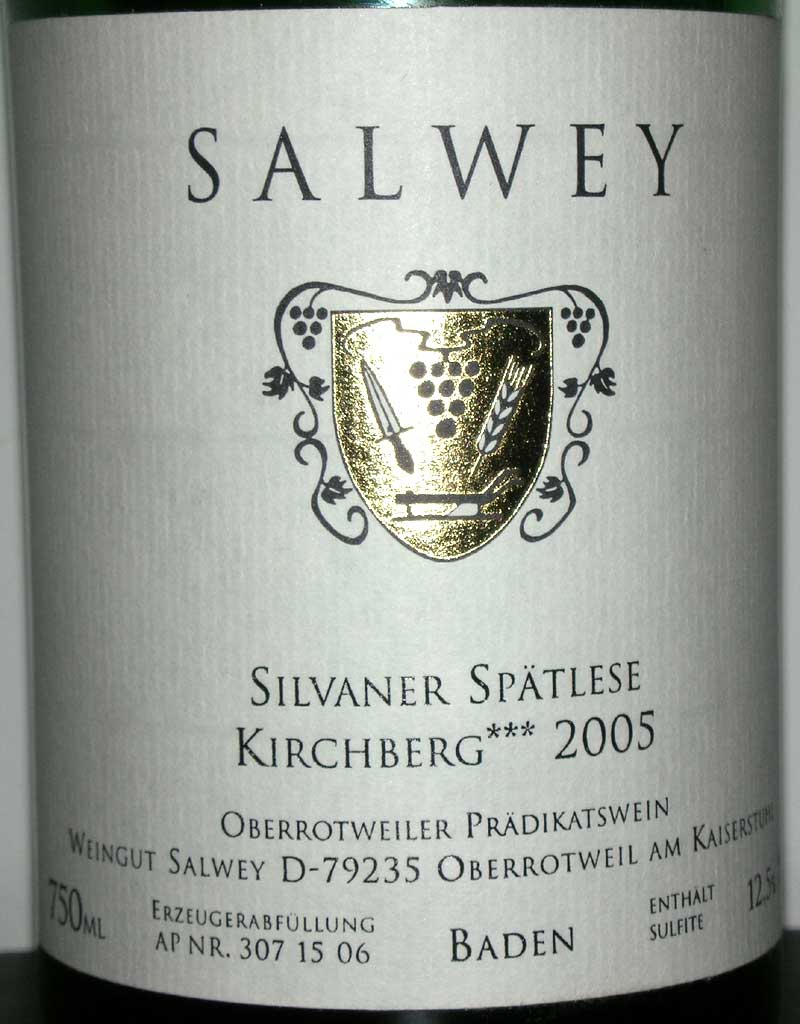
Salwey, Silvaner Spätlese, Kirchberg *** 2005

It is still 2009, the year of the Silvaner grape in Germany - and the Wine Rambler is of course drinking Silvaner. After a full committee meeting last Saturday enjoyed an outstanding Silvaner from Franconia, the London branch of the Wine Rambler jumped right back into Silvaner, this time with a more aged wine - another outstanding example of what a competent winemaker can do with this grape.

Juliusspital, Würzburger Stein, Silvaner Großes Gewächs, 2008

Large wineries owned by immensely land-rich historic trusts are a typical feature of the franconian wine scene, especially in Würzburg. As these go back to charitable - or not so charitable - institutions founded in the late middle ages or the 16th century, they have had some time to accumulate land, assets and reputation. By running wineries alongside hospitals (that's where the "spital"-part comes from), nursing homes and real estate operations, they preserve a forgotten model of business, social services and agriculture whose usefulness must have seemd self-evident to citizens in many premodern cities.

Tamás Pince, Chardonnay, 2007

Before turning to this Hungarian Chardonnay, I feel I have to reveal the source behind my new interest in eastern European wines such as this:

Manfred Klimek a.k.a. Captain Cork is, to me, the freshest and most entertaining voice among German language wine journalists. I particularly enjoy his reports on winegrowers and -makers behind what used to be the iron curtain, because they bring out the passion and personality of individualists who have often not yet mastered winemaker marketing-speak. Highly recommended, 'nuff said.

Back to the Chard, then, and a weird little number it is:

Pale gold, with a hint of onion skin brown. Unusual.

Smells of brown sugar and fried banana, with a salty freshness at the same time. Even more unusual.

Marof, Zeleni Silvanec, 2008

Erich Krutzler, a very well known austrian winemaker, is building up this winery in northern Slovenia- we'll have some more on that in a while.

His Silvaner is made in a light, very clean style, smelling and tasting of fresh green apples, a few herbs and hay. With fresh acidity and a background of chalky mineral, this should make a good companion for salads and light vegetable dishes.
As it is by no means cheap, this one has not completely won me over yet. But, as I said earlier, more is to come.

Graf Hardegg, Syrah Reserve vom Schloss, 2004

Here in the UK, most people would probably associate the Shiraz grape with Australia. Germans and Austrians, however, like to call it Syrah, and if they were into wine they might know that Austria produces a few nice ones too - and this Syrah is one of them.

The colour is a shiny ruby-red that almost borders on dark chocolate or very reduced balsamic vinegar. I am quite definitive about the latter as I served the wine with slow roast lamb, potato mash and balsamic glazed baby carrots. But back to Count Hardegg's Syrah. Both nose and mouth brought some nice ground pepper thunder to the table - and lots of dark berries, embedded in an almost chocolaty smooth structure and garnished with roast bread and some notes of vanilla and roast oak.