dry

These wines are dry, or 'trocken' in German terminology, - either according to our palate or the classification of the winery.

Fürstlich Castell'sches Domänenamt, Casteller Hohenart, Silvaner Kabinett trocken, 2008

Sometimes I think that we should have a wine history segment on the wine rambler. Maybe we will some day. It should be fun to explore some of the microhistory in individual vineyard names, and to maybe get a grip on parts of the larger story of how the wine world that we know and love (well, some of it) came about. The breakup of large noble and monastic estates after 1803 within the crumbling holy roman empire would have to be such a period that changed the landscape of wine making beyond recognition. Or did it?
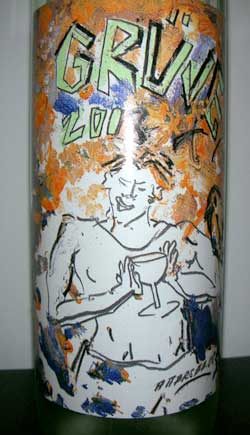
Lukas Krauß, Silvaner Kabinett trocken, 2008

Lukas Krauß, 21 years old, is a winemaker, no that's wrong, he is, proudly, a wine grower („Weinbauer“) from the Pfalz. And not the most prestigious part of the Pfalz, either. He is not listed in many wine guides nor will you have heard his name dropped in the wine blogosphere. But if you, like the wine rambler, are sometimes tired of the visual soft pornography and the worn out old clichés that are wine marketing, and want something that is personal, honest, stylish and funny, here is a name for you to remember, and here also is a site for you to look at:

http://www.lukaskrauss.de

We liked him instantly, and you will soon hear more from Lukas on the wine rambler, something that we look forward to very much.

Postales del Fin del Mundo, Cabernet Sauvignon Malbec 2008

Here I am, drinking a wine from the end of the world. This is both true in geographic terms, seeing as the wine is from Patagonia, and it is also true as the winery is called 'Winery from the end of the world' (Bodega del Fin del Mundo). This Bodega is a fairly new venture, about ten years old, and they grow a variety of red and white varietals on 870 hectares of land. As this part of Patagonia is fairly dry, the vineyards need a computer controlled irrigation system - the water comes from 20 kilometres away and a complete water channel system had to be built for the irrigation. This apparently took two years, and the first vineyards were planted in 1999 - protected from the wind by a complex system of windbreakers. Scared away by all that technology?

Wittmann, Westhofener Riesling trocken, 2008

Wittmann needs no introduction, neither in the german wine scene nor on this site. They are well known as one of the leading lights from Rheinhessen, although it's always worth pointing out that they went seriously organic long before that became fashionable. The Westhofener is their mid-range dry Riesling, somewhere in between the single vineyard Große Gewächse and the simpler varietal QbA.

And you couldn't wish for better if, say, a friend had just fried a piece of tuna in a sesame crust for you:

Deep peachy Riesling fruit, razorlike yet ripe acidity, minerality, a great mixture of fruity power and mineral tension.

Another winner from an estate that seems incapable of making mediocre wine.

Georg Mosbacher, Deidesheimer Leinhölle, Riesling Spätlese trocken 2007

Yellow colour with a shiny golden sparkle - very promising. The nose even better: cool mineral, herbs, lemon and peach - very pleasant peach indeed, but not overwhelming, and some apple, which adds just the right amount of bitter. The peach continues right onto your tongue, giving the Riesling an elegant juiciness, while the apple and especially mineral dominate the first half of the long finish. A wine with good structure, elegance but also a certain assertiveness, Georg Mosbacher's dry late harvest Riesling convinces from start to finish - even two days after I opened the bottle it stays sharp and clear. What can I say, a really good wine!

Weingut Seeger, Cuvée Anna, 2006

When you have a Bordeaux style French red in your glass and it is actually German, it could very well be Thomas Seeger's Cuvée Anna. I opened a bottle Friday night for a group of friends without telling them what it was and the guesses ranged from Argentinian Cabernet to Syrah or French Malbec. In fact, Cuvée Anna is a blend of Pinot Noir, Schwarzriesling and Lemberger. Lemberger is a grape variety also know as Blaufränkisch (especially in Austria), and is know to create wines with sometimes spicy dark berry flavour, some tannins and good acidity - 'Anna' has all of the above. Schwarzriesling, literally Darkriesling, is also known as Pinot Meunier and is interestingly used in the production of Champagne (although Pinot Noir is much better known in this respect).

Dr. Heger, Vitus Spätburgunder 2007

A fairly dark Pinot Noir, the 07 Vitus has a seriously dry nose: smoky, toasted oak, a little yeast and a little cherry fruit - more serious than playful, I would say. The wine is also not very fruity on the tongue, where leather and a hint of pepper are added to the mix. It does not feel heavy though, partly due to its fresh acidity. The finish is good, marinated cherries, acidity and tannins, but reasonably smooth, and a bit of woodland aroma with the tiniest hint of chocolate.

Jurtschitsch Sonnhof, GrüVe Grüner Veltliner 2008

People have very different ideas about wine labels, including people in wineries, of course, and that must be a good thing as it creates a certain variety. The artist-designed label of this year's GrüVe is certainly very distinctive, although I cannot say that I like the way in which it overpowers the whole bottle to the point that you see nothing else. But that just is the tradition of the Sonnhof estate's GrüVe label, an entry level Austrian Grüner Veltliner from one of Austria's premier wineries.

Holger Koch, Grauburgunder Herrenstück, 2008

Sun-kissed Baden, the southernmost of Germany's wine growing regions, specialises on Pinots: Pinot Noir, Pinot Bianco and Pinot Gris/Grigio (or Spätburgunder, Weißburgunder and Grauburgunder), and for some reason we have so far only reviewed Spät- und Weißburgunder from Baden on the Wine Rambler. So it was high time to open a bottle of Grauburgunder and and do some reviewing - and this time it was not just me, but a group of British wine drinkers who joined the London Wine Rambler for a night of fun yesterday.

Clemens Busch, Vom Roten Schiefer, Riesling, 2006

Perhaps unusually for a Mosel winemaker, Clemens Busch is well known for his dry Riesling - he also makes off-dry and sweet wines, but when we visited the winery in 2008 I mostly brought home dry wines. Vom Roten Schiefer - "from red slate" - was one of them.

All starts with a nice golden colour and a nose of a mineral, stone fruit (peach and plum), camomile tea, honey and paraffin wax. All of that made for a substantial, matured impression. On the tongue the Riesling is quite full-bodied and a well rounded, caramel richness. Exotic fruit and ripe plum mix well with noticeable, fresh acidity and a kick of spice. A rich yet elegant wine with a little attitude.